"You'd Be So Nice to Come Home To" is a popular song written by Cole Porter for the 1943 film Something to Shout About, where it was introduced by Janet Blair and Don Ameche. The song was nominated for the Academy Award for Best Original Song in 1943 but lost to "You'll Never Know".
Today's tune is performed by Helen Merrill, taken from her self titled debut studio album, on which she is accompanied by trumpeter Clifford Brown in arrangements by Quincy Jones. Brown had recorded a similar album with Sarah Vaughan only a few days previously, on December 16 and 18, 1954.
In 1995, Merrill recorded a tribute album to Brown, who had been killed in a car accident in 1956, the year after their collaborative album was released.
Helen Merrill (born Jelena Ana Milcetic; July 21, 1930) is an American jazz vocalist. Her first album, the eponymous 1954 recording Helen Merrill (with Clifford Brown), was an immediate success and associated her with the first generation of bebop jazz musicians. After an active 1950s and 1960s, Merrill spent time recording and touring in Europe and Japan, falling into obscurity in the United States. In the 1980s and '90s, she was under contract with Verve and her performances in America revived her profile. Known for her emotional, sensual vocal performances, her career continues in its sixth decade with concerts and recordings.
Today's version was filmed at Festival de Jazz d'Antibes Juan-les-Pins, France July 1960
Betty Harris (born September 9, 1939 in Orlando, Florida, United States) is an American soul singer. Her recording career in the 1960s produced three hit singles that made the U.S. Billboard R&B and Billboard Hot 100 charts: "Cry to Me" (1963), "His Kiss" (1964) and "Nearer to You" (1967). However, her reputation among soul music connoisseurs far exceeds her commercial success of the 1960s, and her recordings for the Jubilee and Sansu record labels are highly sought after in the 2000s by fans of Southern Soul, Northern soul and deep soul.
Soul Jazz Records' fantastic collection Betty Harris' "The Lost Queen of New Orleans Soul" available in new one-off limited-edition heavyweight gatefold special edition green vinyl coloured pressing + download code exclusively for Record Store Day 2022!
Betty Harris's powerful, fiery soulful vocals found a perfect accompaniment with the New Orleans' players that Toussaint put together to back her, which by the time of her funk classic 'There's A Break In The Road' were the legendary super-tight, super-funk New Orleans group THE METERS.
With the extraordinary song-writing skills of Allen Toussaint alongside the powerful, soaring, confident and emotive singer and the groove of THE METERS, you have an unbeatable combination. That Harris never, in fact, lived in New Orleans (she flew in from Florida for all her sessions with Toussaint's local in-house players) seems almost an irrelevance, a geographical aside to the defining New Orleans sound captured on the recordings featured here.
All of these singles featured here were released on Allen Toussaint and his business partner Marshal Sehorn's local New Orleans label Sansu, widely distributed in the southern city but in only limited quantities elsewhere. As a consequence, Betty Harris' music failed to achieve the commercial success of other New Orleans artists such as Lee Dorsey (whom she recorded with) and THE METERS (who backed her). And so at the end of the decade, she stopped recording, retired from the music business to raise her family in Florida.
This is no reflection of the stunning musical quality of all these songs which encompass everything from southern soul, heavy funk, deep soul ballads and northern soul. Betty Harris has been a cornerstone of Soul Jazz Records' New Orleans Funk and New Orleans Soul compilations. Always soulful and always funky, Betty Harris' music contains the essence of New Orleans music. She is the Lost Soul Queen of New Orleans.
Today's tune "Ride Your Pony" is taken from the "The Lost Queen of New Orleans Soul", enjoy today's classic.
"No Moon at All" is a jazz standard written in 1947 by David Mann and Redd Evans.
The version I have for you guys today is with Julie London, she was an American singer and actress whose career spanned more than 40 years. A torch singer noted for her sultry, languid contralto vocals, London recorded over thirty albums of pop and jazz standards between 1955 and 1969. Her recording of "Cry Me a River", a track she introduced on her debut album, was inducted into the Grammy Hall of Fame in 2001. In addition to her musical notice, London was nominated for a Golden Globe Award in 1974 for her portrayal of nurse Dixie McCall in the television series Emergency!.
"No Moon at All" is a track taken from her first album "Julie Is Her Name", released by Liberty Records in December, 1955, under catalog numbers LRP-3006, in monaural form. It was subsequently reprocessed to produce a stereophonic album, and this stereophonic version was released on May 25, 1960 as catalog number LST-7037. The album featured Barney Kessel on guitar and Ray Leatherwood on bass.
"To Hell With Poverty" is a tune by the English post-punk band GANG OF FOUR, formed in 1976 in Leeds.
The tune was released a single in UK but not in US, so the "Another Day/Another Dollar" EP, released in 1982 in the US, by Warner Bros. Records. The release is a compilation of material previously unreleased in the US. The first two tracks were released in the UK as a single. The third track is the b-side of the UK only single "What We All Want," and the last two tracks are excerpted from a live show recorded at the Hammersmith Palais, in London, on 3/30/81. All five songs from the EP later appeared on the EMI Records and Infinite Zero Archive/American Recordings's 1995 CD reissue of the 1981 LP "Solid Gold".
Today's tune "To Hell With Poverty", with an TV live clip of tune, filmed 1980, enjoy!
"Life on Mars?" is a song by English singer-songwriter David Bowie, first released on his 1971 album "Hunky Dory". In 1968, Bowie was commissioned to write English lyrics for the Claude François French song "Comme d'habitude". After his lyrics were rejected, songwriter Paul Anka rewrote it into "My Way", which was made famous by singer Frank Sinatra in 1969. Annoyed at the success of "My Way", Bowie used the song as a template and wrote "Life on Mars?" as a parody of Sinatra's recording. Like other songs Bowie wrote during this period, it was written primarily on piano. Recording for "Life on Mars?" took place on 6 August 1971, the final day of the Hunky Dory sessions. Co-produced by Bowie and Ken Scott, the backing band consisted of guitarist Mick Ronson, bassist Trevor Bolder and drummer Mick Woodmansey; Ronson also composed the song's string arrangement. After failing to acquire pianist Dudley Moore, piano was played by Strawbs member Rick Wakeman.
Musically, "Life on Mars?" is described as a "soaring, cinematic ballad". It is primarily glam rock, with elements of cabaret and art rock. The song has a complex structure, containing different chord changes throughout. The instruments act in tandem with one another and Bowie's vocal, steadily growing throughout its runtime. Lyrically, the song describes a girl who goes to the cinema to escape reality, using numerous surreal images. It thematically reflects optimism and the effects of Hollywood. Despite its title, the song has no connection to Mars itself; it is instead a reference to a then-recent media frenzy between the United States and Soviet Union.
At the height of Bowie's fame as Ziggy Stardust, RCA Records issued "Life on Mars?" as a single on 22 June 1973 in the United Kingdom, where it peaked at number three on the UK Singles Chart and stayed on the chart for thirteen weeks. The single release was promoted by a promotional video shot by photographer Mick Rock, featuring a made-up Bowie in a turquoise suit performing the song against a white backdrop. Bowie performed the song during his concerts frequently throughout his career, performances of which have appeared on several live albums. The song also has appeared on numerous compilation albums and was remixed by Scott in 2003 and 2016, the latter being a 'stripped down' mix. The 2016 mix was accompanied by a remastered and reedited version of Rock's video.
"Life on Mars?" is considered by biographers and reviewers as one of Bowie's finest songs, with many describing it as a masterpiece. Praise is also given to Bowie's vocal performance and growth as a songwriter. Several publications have also considered it one of the greatest songs of all time. The song was the namesake of the British television series Life on Mars and has featured in other films and television shows. Artists who have covered the song include singer Barbra Streisand and Nine Inch Nails members Trent Reznor and Atticus Ross. The song charted worldwide following Bowie's death in 2016 and became a frequent tribute song for the artist; tributes by Nicholas Freestone and singer Lorde garnered widespread attention.
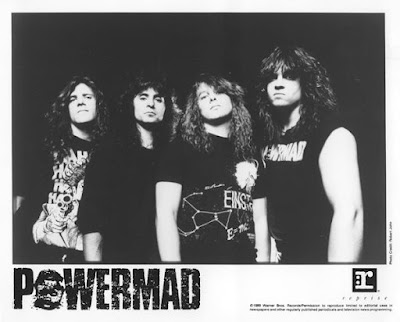
POWERMAD is an American speed metal band, formed in Minneapolis in 1984. The group has been called an "innovative and often forgotten speed metal band...who infused progressive metal styles and European styles into abstract American speed metal." The band's intricate riff formulations were heavily influenced by thrash metal acts like METALLICA and TESTAMENT. Vocalist Joel DuBay's singing is easily recognizable with his mixture of singing and high screams.
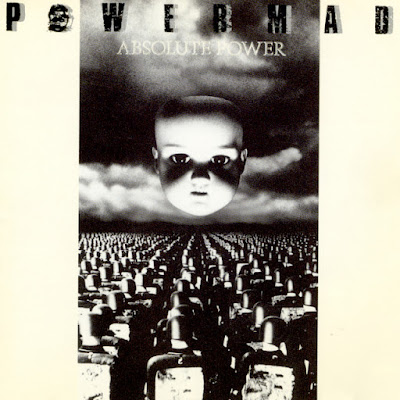
Their first and only full-length album until 2015, "Absolute Power", was released in 1989. Other than a US tour opening for OVERKILL, a video featured on MTV of their single "Nice Dreams" and a cameo appearance in the David Lynch film "Wild at Heart" (where they go from playing their own music to Elvis Presley's with Nicolas Cage singing), POWERMAD never achieved notable commercial success. Their releases in the 1980s, however, were critically acclaimed and are considered collectors items today by fans of thrash and speed metal music.
Today's tune "Nice Dreams" is taken from the album "Absolute Power", enjoy!
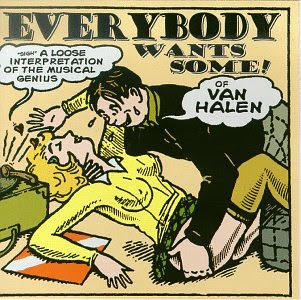
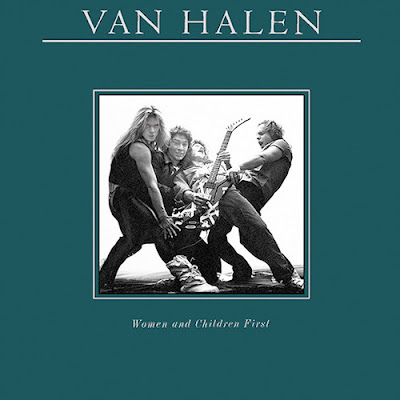
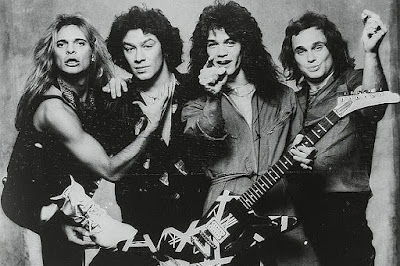
"Everybody Wants Some!!" is a song by the American hard rock band VAN HALEN it is the second track off their 1980 album "Women And Children First". It is one of the band's most popular songs, starting as a concert highlight throughout the band's early career.
The song is rife with experimental features including a "jungle" drum and Tarzan-like vocal introduction and some new guitar playing techniques from guitarist Eddie Van Halen. The drum-vocal interlude or breakdown section has an improvised feel, with Roth ad-libbing conversational dialogue; for example, he begins the section by saying “I like…” before being cut off by Eddie striking a guitar chord, then finishes "I like the way the line runs up the back of the stockings". At the very end of the song, Roth quips, "Look, I'll pay you for it, what the fuck?" However, the song fades out to where the obscenity is not entirely audible.
The song was a staple on all of the tours with Roth, following its release. Often, the band would stop in the middle of the song and Roth would chat with the crowd for several minutes before finishing the song. In later years, with their later lead singers, VAN HALEN would use the opening drum beat from this song as an introduction into "Panama."
The song appeared in the 1985 comedy Better Off Dead in a humorous Claymation scene. It is also featured in the 2009 horror-comedy Zombieland. The 1999 Judd Apatow-produced comedy Freaks and Geeks featured the song in episode 9, "We've Got Spirit". It is also featured in the 2016 Richard Linklater film Everybody Wants Some!!
The song appeared in the 2001 comedy film Joe Dirt.
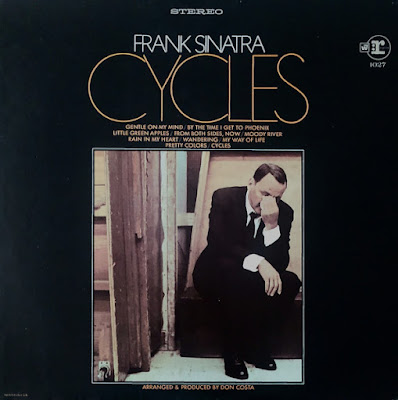
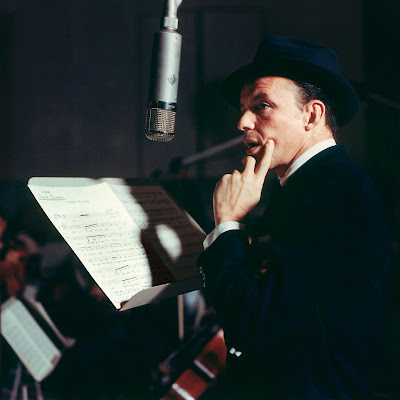
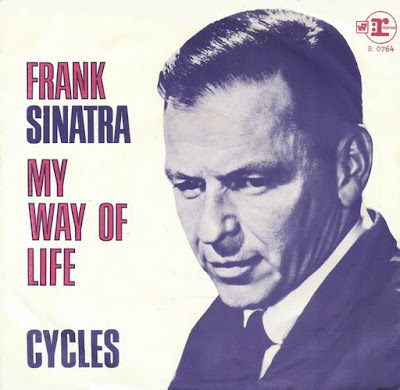
"Cycles" is a studio album by American singer Frank Sinatra, released in 1968.
Released just before Christmas in 1968, there was a ten-month gap between the release of Francis A. & Edward K. and this album, which was the longest period in Sinatra's Reprise years in which he did not commercially record music (barring his contributions to The Sinatra Family Wish You a Merry Christmas).
Sinatra sang a variety of folk-rock oriented songs, including Judy Collins' hit "Both Sides Now" (written by Joni Mitchell) and the Glen Campbell hits "Gentle on My Mind" (written by John Hartford) and "By the Time I Get to Phoenix" (written by Jimmy Webb). The title song was released as a single, reaching #23 on the Billboard Hot 100 chart and #2 on the Easy Listening chart, while the album peaked at #18 on the Billboard 200 chart.
Today's tune "Cycles", the title tune from the album, the song was written by (Gayle Caldwell), the song is a really beautiful piece where Franks' voice really dig deep into your heart, enjoy!
"Hallogallo" is a tune by German krautrock band NEU!, taken from the debut album Neu!. It was released in 1972 by Brain Records. It was the first album recorded by the duo of Michael Rother and Klaus Dinger after leaving KRAFTWERK in 1971. They continued to work with producer Konrad "Conny" Plank, who had also worked on the KRAFTWERK recording sessions. They released three albums in their initial incarnation—Neu! (1972), Neu! 2 (1973), and Neu! 75 (1975)—before disbanding in 1975. They briefly reunited in the mid-1980s.
Though NEU! had minimal commercial success during its existence, the band is retrospectively considered a central act of West Germany's 1970s krautrock movement. They are known for pioneering the "motorik" beat, a minimalist 4/4 rhythm associated with krautrock artists. Their work has exerted a widespread influence on genres such as electronica and punk.
Enjoy today's tune "Hallogallo" (Play on "Halligalli", a German slang term for "wild partying", with the word "hallo" being German for "hello").
"Wrong name, wrong face, wrong time, wrong place." Is the first line of today's classic "I Want The Moon", taken from the English punk band LEATHERFACE's third full-length album "Mush". It was originally released only in Britain on Roughneck, a subsidiary of Fire Records, in 1991. It was re-released on Seed Records, an offshoot of Atlantic Records, in 1992, in an unsuccessful attempt to capitalize on the popularity of NIRVANA in the United States.
The Guardian called it an album "which has influenced every hardcore, post-hardcore, call it what you want, punk group that exists anywhere across the globe." Kerrang rated it as one of the 50 best albums of 1991.
In 2012, Sarah Anderson of NME named it one of "20 lost albums ripe for rediscovery", and the same magazine named it the 49th best album of 1991 in 2016.
LEATHERFACE were a British punk rock band from Sunderland, Tyne and Wear, fronted by Frankie Stubbs. Trouser Press called them "England's finest, most exciting punk band of the 90s" and The Guardian has called them "the greatest British punk band of the modern era."
Enjoy today's tune "I Want The Moon", taken from the album "Mush".
"Anything" is a single by the English rock band THE DAMNED, released 6 November 1986 on MCA. Previewing the group's new album of the same name, the song saw a slight move away from the Goth rock of Phantasmagoria, to a more mainstream rock sound. The single received lukewarm reviews, and considering the success of the previous album and "Eloise", its UK Singles Chart peak of No. 32 was seen as a disappointment.
THE DAMNED formed in London in 1976 by lead vocalist Dave Vanian, guitarist Brian James, bassist (and later guitarist) Captain Sensible, and drummer Rat Scabies. They were the first punk rock band from the United Kingdom to release a single, "New Rose" (1976), release an album, "Damned Damned Damned" (1977), and tour the United States. They have nine singles that charted on the UK Singles Chart Top 40.
As one of the first gothic rock bands, THE DAMNED were a major influence on the goth subculture with lead singer Vanian's vampire-themed costume, baritone singing voice and dark lyrics being major influences.
Enjoy today's tune "Anything", the lead track from the seventh studio album "Anything".
Today's tune "Put The Message In The Box" is a by British alternative rock band WORLD PARTY, taken from the second studio album "Goodbye Jumbo", released on 24 April 1990 on Ensign Records.
The album received generally positive reviews from critics and peaked at No. 73 on the US Billboard 200 and No. 36 on the UK Albums Chart. "Way Down Now", the album's lead single, spent five weeks at number one on the Billboard Alternative Songs chart, and follow-up single "Put The Message In The Box" reached No. 8.
In a contemporary review for the Chicago Tribune, Greg Kot noted heavy influence from THE BEATLES in the album's "sense of pop and studio craft" and wrote that the biting humor and irony expressed in Wallinger's lyrics was balanced out by "memorable melodies and moments", calling all the album's songs "worth savoring." Chris Willman of the Los Angeles Times felt that his "Lennonisms sound somehow endemic, not affected" and the wide range of musical influences on "Goodbye Jumbo" did not constitute "petty theft", stating that the album "comes together marvelously." Don McLeese of Rolling Stone wrote that Goodbye Jumbo "displays an ambition as broad as the emotional range of its music" and that while Wallinger's "missionary zeal occasionally belabors his messages", the album's music is "sufficiently vital to overpower resistance". Spin's Jon Young dubbed it as a "winning opus". One detractor was Robert Christgau of The Village Voice, who assigned the album a "dud" rating, indicating "a bad record whose details rarely merit further thought".
World Party are a British musical group, which is essentially the solo project of its sole member, Karl Wallinger. He started the band in 1986 in London after leaving The Waterboys.
"Goodbye Jumbo" was named the fifteenth best album of 1990 in The Village Voice's year-end Pazz & Jop critics' poll. It was named as Album of the Year by Q in 1990, with the album also receiving a nomination for a Grammy Award for Best Alternative Music Album the same year. In 2000, Q placed it at number 94 in its list of the 100 Greatest British Albums Ever.
In 2000 it was voted number 474 in Colin Larkin's All Time Top 1000 Albums.
"The Chauffeur" is a song by English band DURAN DURAN, taken from their second album "Rio", originally released worldwide on 10 May 1982.
DURAN DURAN are an English new wave band formed in Birmingham in 1978. The group was a leading band in the MTV-driven Second British Invasion of the US in the 1980s. The group was formed by keyboardist Nick Rhodes and bassist John Taylor, with the later addition of drummer Roger Taylor, and after numerous personnel changes, guitarist Andy Taylor (none of the Taylors are related) and lead singer Simon Le Bon. These five members featured in the most commercially successful line-up.
Like several other songs on Rio, "The Chauffeur" contains sound samples thanks to Nicks Fairlight CMI - the world's first commercial sampler. According to a question on Ask Katy, the sample was taken “from a nature record that the band found. The man is talking about ‘insects in the grass’". No track or album under this name has yet been discovered.
Today's tune "The Chauffeur" was directed by Ian Emes and is one of two non-single tracks on Rio to have its own music video. None of the band appear in the video at all. It is a moody black-and-white piece inspired in part by the film, The Night Porter, and the photography of Helmut Newton. Two women dress themselves carefully in lingerie and drive through the streets of London towards a rendezvous with each other in an abandoned multi-storey car park. The instrumental end piece of the song was accompanied by a topless Perri Lister performing a sensuous dance - clearly an homage to Charlotte Rampling's topless "Dance of the Seven Veils" in The Night Porter.
"I Was Dancing In The Lesbian BarI Was Dancing In The Lesbian Bar", is a tune taken from the fourth solo album "I, Jonathan" by the American singer, songwriter and guitarist Jonathan Richman, released by the Rounder Records label in 1992.
As the founder of influential protopunk band THE MODERN LOVERS, Richman had strived to convey authentic emotions and storytelling with his music. "I, Jonathan" continued this aesthetic with simple and sparse rock and roll arrangements, and straightforward lyrics about mundane topics.
Songs on the album addressed topics such as backyard parties ("Parties in the U.S.A"), memories of neighborhoods in which Richman had lived ("Rooming House on Venice Beach" and "Twilight in Boston") and his admiration of his primary musical inspiration, the VELVET UNDERGROUND ("Velvet Underground"). The latter song includes a brief interlude of the VELVET UNDERGROUND song, "Sister Ray".
The album helped increase Richman's cultural profile, which would include a 1993 appearance on Late Night with Conan O'Brien during which Richman performed one of the album's songs, "I Was Dancing In The Lesbian Bar".
Enjoy today's classic "I Was Dancing In The Lesbian Bar"
"I Had Too Much to Dream (Last Night)" is a song written with music by Annette Tucker and lyrics by Nancie Mantz, which was recorded in late 1966 by the garage rock band THE ELECTRIC PRUNES. Released as the band's second single November 1966.
It was also the lead track of the band's debut album, and became more widely known as the opening track on the influential Nuggets compilation of garage rock and early psychedelic music, released in 1972.
The title is a play on words, namely on having "too much (alcohol) to drink": its lyrics describe how the singer has woken from dreaming about an ex-lover.
THE ELECTRIC PRUNES originally formed as THE SANCTIONS at Taft High School in Los Angeles, renaming themselves in 1966. They were introduced to record producer Dave Hassinger, and after a series of rehearsals at Leon Russell's house released a debut single, "Ain't It Hard". Despite its commercial failure, Reprise Records agreed that the band could record a second single.
Convinced that the band could not write their own songs, Hassinger sought material from the professional songwriting team of Annette Tucker and lyricist Nancie Mantz. One of the tunes was "I Had Too Much to Dream (Last Night)", a song that, according to some sources, was originally conceived as an orchestral piano ballad. However, according to Tucker, "I came up with the title one day and called Nancie. She loved it and we wrote it the next day in one half hour....The words were there and my melody came easily. I was influenced by the Rolling Stones at the time and that is how I heard that song being recorded....Nancie and I envisioned this as a rock song." A demo version recorded for Hassinger by singer-songwriter Jerry Fuller (in some sources wrongly identified as Jerry Vale), may have been the source of the story of the song's origin as a ballad.
At the time, THE ELECTRIC PRUNES comprised singer James Lowe, lead guitarist Ken Williams, rhythm guitarist James "Weasel" Spagnola, bassist Mark Tulin, and drummer Preston Ritter. The oscillating, reversed guitar which opens the song originated from the rehearsals at Russell's house, where Williams recorded with a 1958 Gibson Les Paul guitar with a Bigsby vibrato unit. According to Lowe, "We were recording on a four-track, and just flipping the tape over and re-recording when we got to the end. Dave cued up a tape and didn't hit 'record,' and the playback in the studio was way up: ear-shattering vibrating jet guitar. Ken had been shaking his Bigsby wiggle stick with some fuzztone and tremolo at the end of the tape. Forward it was cool. Backward it was amazing. I ran into the control room and said, 'What was that?' They didn't have the monitors on so they hadn't heard it. I made Dave cut it off and save it for later."
The single was released in November 1966. At first it was caught up in the Christmas rush, but in early 1967 it made steady progress up the US chart and finally peaked at #11. It also reached # 49 in the UK chart. Its success enabled the band to tour, and to release an album and a successful follow-up single "Get Me to the World on Time".
Born more by accident than intent, TONES ON TAIL began life simply as a request...a request by BAUHAUS' guitarist Daniel Ash to borrow house mate & BAUHAUS back-line engineer Glenn Campling's then state of the art Dr. Rhythm Boss DR55 drum machine.
With Daniel keen to experiment with new ideas deemed "unsuitable" for BAUHAUS, and Glenn nurturing an almost obsessive interest in the latest technology, a partnership of sorts evolved. The genesis of TONES ON TAIL's future was created in the back of the tour van on the way home from a Bauhaus gig in Reading in October of 1981...
Although it would be some five months before the first fruits from this embryonic partnership were tasted, this particular fruit; Copper (playable at both 45 and 33 rpm!) was one of a culmination of four tracks that would constitute their first eponymous titled four track 12" single. Issued on the seminal 4AD imprint, TONES ON TAIL was a masterpiece in experimental pop, an assemblage of Eno tinged sound-scapes.Ash and Campling initially began stockpiling material and ideas during breaks in their respective hectic BAUHAUS schedules, however, like the phoenix of legend, emerged with bright, shiny, vibrant new colours from the fall-out of the latter's slow, dark disintegration.
Writing and recording initially as a duo until the Spring of 1983, when Ash's former BAUHAUS cohort Kevin Haskins was recruited to add a real, authentic drum sound. Together for little over two years TONES ON TAIL was, much like the mythological Lernaean Hydra, a multi-faceted beast. They successfully created a myriad of sound and style much too complex to even begin to categorise. Affectionately, summed up recently by Campling, as Dr. Frankenstein creating little monsters in a sound lab!
TONES ON TAIL were dissolved in the fall of 1984 but like BAUHAUS before them, left behind some of the most original and highly influential pieces of music ever committed to tape.
Today's tune "Lions" is taken from the only studio album "Pop" by the English post-punk band TONES ON TAIL, a side project of the BAUHAUS members Daniel Ash and Kevin Haskins (who later went on to form LOVE AND ROCKETS with David J), and the BAUHAUS roadie Glenn Campling. It was released on 6 April 1984 by the Beggars Banquet record label. The clip is Live at Glasgow, Nite Moves - May 1984
"Mighty Wings" is a song by the American rock band CHEAP TRICK, released in 1986 as the third single from the soundtrack of the film Top Gun. It was written by Harold Faltermeyer and Mark Spiro, and produced by Faltermeyer.
Despite the commercial success of the Top Gun soundtrack, and unlike the four other singles culled from the album, "Mighty Wings" failed to make an appearance in the Billboard chart. It was the third of five singles to be released from the soundtrack, following "Danger Zone" by Kenny Loggins and "Take My Breath Away" by Berlin.
In the film Top Gun, the music (without vocals) is played in the first training session at Miramar, while the full version with vocals is played during the ending credits.
The song has been credited as an influence on Ken's theme music from the Street Fighter II videogame. Composer Yoko Shimomura stated: "I watched the movie before I composed the song, so I can't deny I may have been inspired subconsciously. But I didn't go into it thinking, 'OK I'm gonna make this song sound like Mighty Wings'."
Today's tune "Mighty Wings" by CHEAP TRICK, taken from the soundtrack "Top Gun", enjoy!
Cracked Actor was originally a song from David Bowie's 1973 album, "Aladdin Sane". It was subsequently performed on the 1974 "Diamond Dogs" tour, and was included on the David "Live" album.
Like most of the older material played on that tour, "Cracked Actor" was rearranged to suit Bowie's new "Soul Man" direction. Some of the rearrangements fared better than others, in my opinion. In the case of Cracked Actor, I love what they did with it, especially when the performance aspect is seen.
"Cracked Actor (Live in Los Angeles 1974)" was lined up for Record Store Day.
The first is Cracked Actor (Live in Los Angeles 1974), the first official release of his Philly Dogs Tour show from September 1974, which partly featured in Alan Yentob’s BBC documentary, Cracked Actor. The tracks were mixed by long time Bowie collaborator Tony Visconti.
The full concert will be released on a triple vinyl with the last side reserved for an etching of the Diamond Dogs era Bowie logo. The packaging also features newly commissioned artwork with rare and unseen photographs. Never picked it up, which was stupid, hoping to find it on the way forward.
Enjoy today's tune "Cracked Actor" where the clip is filmed Live at the Universal Amphitheatre - 09/05/1974
Got a flash on the social media about the infamous axe murderer (Lizzie Borden) and got to think about the classic heavy metal band LIZZY BORDEN.
LIZZY BORDEN was founded by brothers Gregory Charles Harges (Vocals) and Joey Scott Harges (Drums) back in 1983. To date, the band has charted on the Billboard 200 four times. LIZZY BORDEN is eponymous of the band's lead vocalist.
Today's tune "Me Against The World" is taken from the third album "Visual Lies", an album featuring David Lee Roth and Ozzy Osbourne guitarist Joe Holmes, credited as J. Holmes. It features their best known song "Me Against The World" for which the band shot a promotional video. The track was also featured in the 1987 heavy-metal horror film, "Black Roses". The movie remains a cult-classic among 80's glam metal fans. The album was released September 5, 1987, enjoy!